ELEVATE Wiki

Introduction
ELEVATE is a repository of open-source capabilities by ShikshaLokam that aims to empower leaders with tools to drive sustainable, population-scale change. At ShikshaLokam, we believe that leaders are the primary agents of change, and while top-down directives are important, bottom-up action by leaders is equally critical for sustained success. However, effective bottom-up action relies on empowering leaders with adequate support, knowledge, and tools. And technology is a lever that can provide all of this systematically, and at scale. ELEVATE is designed to be that proven technology toolbox that any leadership development organization can use to build contextually relevant solutions for their leaders quickly and easily.
Affecting change through bottom-up leadership development is a continuous process and it relies on giving leaders the right support, knowledge, and tools to address challenges. And enabling this process is the primary objective of ELEVATE capabilities. ELEVATE aligns with ShikshaLokam’s Theory of Change, which emphasizes four core verbs: Sense, Make-Sense, Learn, and Improve.
The Theory of Change
ShikshaLokam’s Theory of Change is a description of the general process that all leaders would follow in any continuous improvement initiative. The process is described with four primary verbs:
- Sense: Identifying and understanding challenges within a specific context.
- Make-Sense: Analyzing and interpreting data to derive actionable insights.
- Learn: Building individual and collective capabilities to address challenges.
- Improve: Driving continuous improvement and as a result scaling impactful practices.
Explore more about the Theory of Change here
ELEVATE’s capabilities are intrinsically tied to this Theory of Change. For each of these core verbs, there are corresponding modular and configurable tools within the ELEVATE repository.
ELEVATE brings together a growing set of AI-enabled capabilities that support education leaders across the continuous improvement journey of Sense, Make Sense, Connect, Learn, and Improve. MItra listens to voices and experiences from the ground, helping leaders Sense lived experiences, emerging needs, and challenges. The Insights Agent helps Make Sense of these experiences by surfacing patterns, connections, and actionable insights. Knowledge Commons enables Learning by bringing relevant knowledge, experiences, and solutions within reach, while Saathi supports Improvement by helping leaders translate learning into contextual, actionable next steps. Together, these capabilities connect experience, insight, knowledge, and action, enabling leaders to make more informed decisions, learn continuously, and drive meaningful change in their contexts.
In this way, AI is progressively reimagining ELEVATE’s Theory of Change. Rather than simply digitising individual steps in the improvement journey, AI is beginning to connect them more intelligently and seamlessly. Experiences captured from the ground can be synthesised into insights; insights can be connected to relevant knowledge and perspectives; and learning can be translated into contextual action. Each action can, in turn, generate new experiences and evidence that feed the next cycle of improvement. AI therefore strengthens the ability of ELEVATE to make the journey more responsive, contextual, personalised, and continuous, while keeping education leaders at the centre of decision-making and action.
This builds on ELEVATE’s foundational capabilities of Observations/Surveys, Projects, Mentoring, and Reports, which have long enabled leaders to navigate this improvement cycle. Observations and Surveys help surface experiences and needs; Reports bring together data to identify patterns and opportunities; Mentoring enables leaders to connect, exchange perspectives, and learn from one another; and Projects provide a pathway to translate learning into action. Together, these capabilities established the foundation for a continuous improvement approach grounded in Agency, Collaboration, and data-informed action. AI now extends this foundation, helping ELEVATE move from enabling the improvement cycle to intelligently supporting leaders across the cycle.
Design Principle
ELEVATE’s technology aligns with NDEAR principles, ensuring:
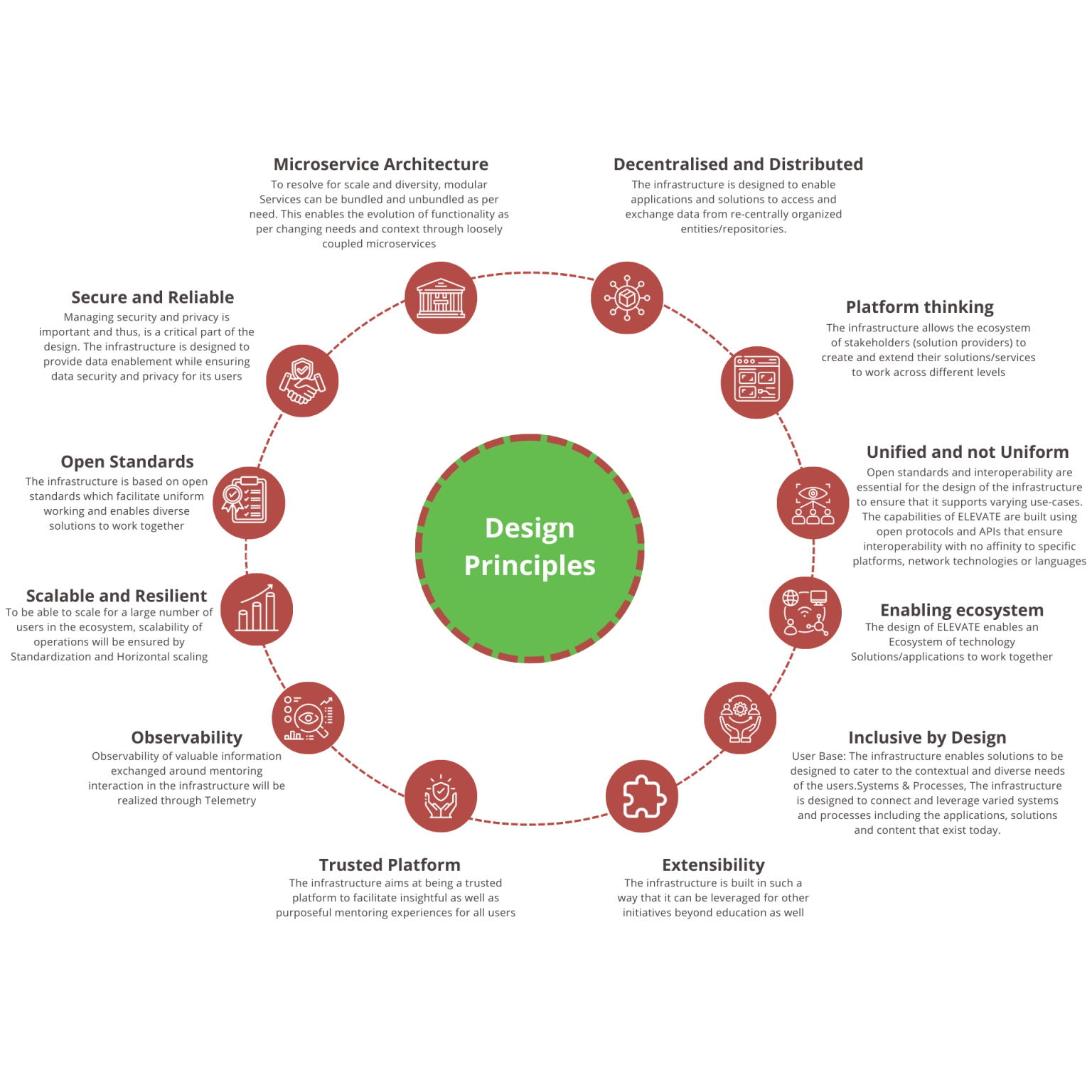
These principles ensure scalability, adaptability, and sustainability while fostering collaboration and empowering local solutions.
design principles matter because they provide a structured framework for creating systems that are not only functional but also sustainable, scalable, and adaptable. Technically, these principles guide the selection of appropriate technologies, design patterns, and frameworks, ensuring that the infrastructure is optimized for current performance while being flexible enough to accommodate future growth and integration needs.
Principles like modularity help teams break down complex systems into smaller, independent modules, making them easier to maintain, extend, adapt, and scale over time. This approach ensures the system can evolve without disrupting core functionalities. Interoperability is another key principle, ensuring that different components or services can communicate seamlessly, allowing the system to adapt to changing requirements and new technological innovations.
Security by design and performance optimization are also crucial. By embedding security measures from the start, design principles prevent vulnerabilities and protect sensitive data. Performance considerations, such as load balancing, caching, and database optimization, ensure that the system remains efficient under high demand, supporting scalability and long-term sustainability.
Incorporating these design principles into the development process ensures that the system not only meets current needs but is also prepared to evolve with future technological advancements and changing user demands. Ultimately, design principles act as a foundation for building reliable, efficient, and future-proof systems that can grow with confidence at population scale in a rapidly changing world.
ELEVATE Adoption Models
Organizations can set up and deploy ELEVATE capabilities as an independent solution, selecting and configuring any core capability based on their specific needs. This flexible approach allows adopters to tailor their ELEVATE implementation to align with their objectives.
- Organizations can adopt and deploy any of ELEVATE’s core capabilities listed below
- Mentor
- Projects
- Observations/Surveys
- Reports
- MItra
- Supporting services
- Modular selection enables organizations to configure and deploy only the capabilities they require.
- Independent deployment allowing full control over infrastructure, branding, and integration of the capability adopted.
Use cases
- MItra
- Discussion and Story Capture: Document community meetings, chaupals, individual and group conversations in multiple languages.
- Guided Reflection: Use conversational prompts to capture challenges, actions, effort and impact.
- Evidence Collection: Collect supporting evidence such as photographs alongside stories.
- Structured Output: Convert voice conversations into structured stories, reports and insights.
- Review & Edit: Allow users to review, refine and add details before finalising outputs.
- Evaluation Studies: Conduct FGDs, interviews, baselines, endlines, validations and programme evaluations at scale.
- Perception & Feedback Capture: Understand what communities, parents, teachers and other stakeholders think, feel and value about schools, communities and the future.
- Mentor
- Educational Institutions: A university deploys the Mentor capability to facilitate peer and faculty mentorship programs, helping students receive academic and career guidance.
- Corporate Training: A company sets up Mentors to pair employees with experienced mentors, fostering professional growth and knowledge sharing within the organization.
- Projects
- EdTech Platforms: An online learning platform integrates Projects to enable students to work on real-world assignments and track their progress through structured tasks.
- Non-Profit Organizations: An NGO uses Projects to manage and track community service initiatives, ensuring accountability and impact measurement.
- Observations/Surveys
- Government Initiatives: A government education department adopts Observations/Surveys to evaluate classroom practices and teacher performance across public schools.
- Healthcare Providers: A hospital deploys Surveys to collect patient feedback on services, improving healthcare delivery and patient satisfaction.
- Best Fit: Organizations looking for a standalone solution that is fully configurable and deployable within their own infrastructure.
Organizations can integrate selected ELEVATE capabilities into their existing platforms, ensuring seamless functionality while maintaining their branding and infrastructure
Key Features:
- Customizable Progressive Web Application (PWA) and backend service integration for adopted capabilities.
- Tailored branding and user experience to match the organization’s ecosystem.
- Flexible embedding of core functionalities such as Mentoring, Projects, Observations & Surveys into existing systems.
- Interoperability with the organization’s existing technical stack through APIs and integrations.
Use Cases:
- Community & Programme Engagement: Organisations integrate ELEVATE’s MItra voice-enabled bots to capture grassroots experiences, challenges, feedback, stories, and solutions in regional languages, converting conversations into structured insights that inform programmes, evaluations, and action.
- Government Initiatives: A government education department integrates ELEVATE’s observation and survey features into its existing teacher training system.
- EdTech Platforms: An online learning platform embeds ELEVATE’s mentoring feature to enhance student support and guidance.
- Corporate Learning Management Systems (LMS): A company integrates ELEVATE’s project tracking module into its LMS to provide structured learning experiences.
Best Fit: Organizations with an established digital infrastructure looking to enhance their offerings with select ELEVATE capabilities while maintaining control over their brand identity and platform.
Getting Started with ELEVATE
As an adopter, you’ll be using ELEVATE’s capabilities to create customized, scalable solutions that meet your specific needs. Here’s a step-by-step guide to get you started:
- Define Your Objective
Before diving in, clarify the specific challenges or goals you want to address. Whether you’re aiming to enhance leadership development, conduct large-scale surveys, or implement a mentoring program, understanding your objectives will guide your choice of capabilities. - Explore the Capabilities
Visit the ELEVATE capability page and familiarize yourself with the different capabilities available. Each capability offers a specific function such as observations, surveys, projects, mentoring, or reports. Check the details of each to see which ones align with your needs. - Select the Right Capabilities
Choose the capability that directly aligns with your goals. For instance, if your goal is data-driven leadership development, explore the Observations/Surveys block. If you need to create a mentoring program, look into the Mentor capability. Each capability is designed to address specific needs, and you can mix and match them to create customized solutions. - Configure the Capability to Fit Your Context
ELEVATE’s capabilities are highly configurable and can be tailored to suit your geography, domain, and specific organizational needs. Customize elements like survey questions, mentoring frameworks, or project tracking parameters to ensure relevance and impact. This flexibility ensures your solution is as effective as possible, regardless of your unique challenges. - Seamlessly Integrate into Existing SystemsELEVATE’s capabilities are designed for easy integration.You don’t need to overhaul your existing systems. Instead, the capabilities fit into your workflows, enhancing your current programs without disruption.
- Deploy and Monitor Results
Once configured, deploy the capabilities and monitor how they perform. Regularly review the progress of the initiatives and fine-tune the configurations as necessary. ELEVATE’s tools are designed for continuous improvement, so you can adapt over time for better results. - Join the ELEVATE Community
ELEVATE’s success lies in community collaboration. Share your experiences with other adopters through forums, testimonials or user groups. Seek feedback, offer suggestions, and learn from the collective knowledge of the ELEVATE community. Engaging with others can help you optimize your use of the capabilities and drive innovation in your programs.